
 20 People Skills Lessons That Will Improve Your Communication and Relationships
Most people do not need to become more charismatic. They need better reps (meaning real-life practice). Because when social pressure hits, you do not rise to your intentions. You fall to your defaults, tone, pace, defensiveness…your need to be right. Or you revert to your habits of going vague, going quiet, or trying too hard.
The good news is this people skills are trainable.
People skills are not some fixed trait you either have or do not have. They are a set of behaviors you can practice. And the more you practice them, the more natural they become.
This is not therapy, and it is not a lecture. Think of it like a field guide you can actually use. Read it straight through, or treat it like a menu and start with the lesson you need most right now.
Part 1: The Foundation of Strong People Skills
1) What “people skills” actually are.
People skills are not performance, they are calibration.
In other words, they are your ability to notice what is happening in you, in the other person, and in the room. They allow you to make a small adjustments that helps the interaction land better.
That is why socially strong people often do not look flashy. They just feel easy to be around.
Try this: Before your next important conversation, ask yourself:
- What is the mood here?
- What does this person need most right now?
- What is one small adjustment I can make?
2) Presence: attention as the core superpower.
Presence is not confidence. Presence is attention.
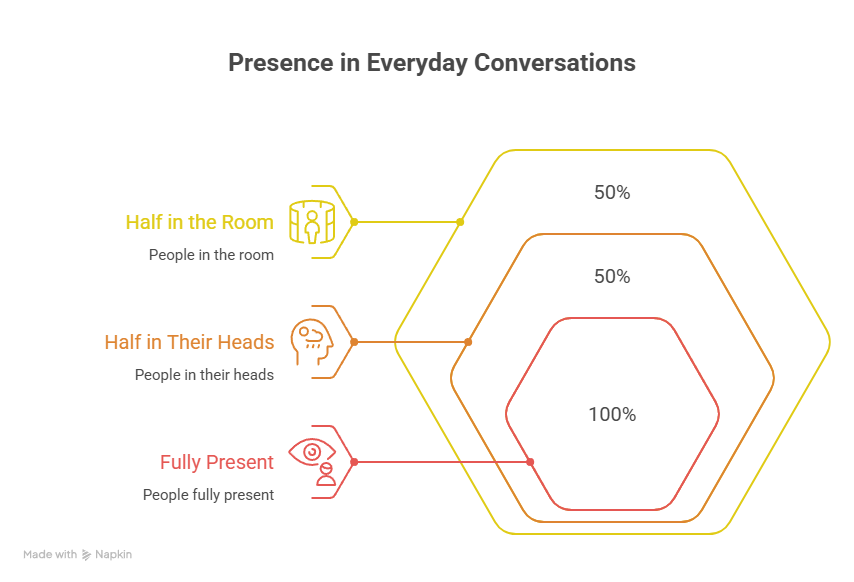
Most people are half in the room and half in their heads. They are rehearsing what to say, wondering how they are being perceived, or thinking about the next thing.
Presence is what happens when your attention lands fully on the moment.
That alone will make you better in business, marriage, fatherhood, friendships, and everyday conversations.
Try this: Before speaking, take one breath and think, “Be here.”
3) First impressions: warmth + competence balance.
People usually make a fast read on you based on two things:
- Are you warm?
- Are you capable?
If you come across as competent but cold, people may respect you but not relax around you. If you come across as warm but unclear, people may like you but not trust your leadership.
The sweet spot is warmth first, then competence.
Try this: Open with warmth, then frame the interaction clearly.
Example: “Good to see you. Glad we’re connecting. Here’s what I’d love to cover.”
4) Asking better questions.
Better conversations come from better questions. Most people stay on the surface because their questions stay on the surface. The best questions move gradually from facts to experience to meaning.
Instead of asking flat questions, ask questions that open people up a little.
Examples:
- Instead of “How’s work?” ask “What’s been taking the most energy lately?”.
- Instead of “How was your day?” ask “What part of the day felt the heaviest?”.
- Instead of “What happened?” ask “What did that mean for you?”.
Try this: In one conversation today, ask one question that goes one layer deeper than usual.
5) Listening that changes how people feel.
A lot of people think good listening means staying quiet. That is part of it, but it is not enough. People feel listened to when they feel accurately understood.
The simplest way to do that is to reflect what you heard, then confirm it.
Examples:
- “So what I’m hearing is…”
- “It sounds like the hard part is…”
- “Is that right?”
That one move lowers defensiveness fast.
Try this: Reflect back the essence of what someone said before giving your opinion.
6) Conversational flow: threading and transitions.
Awkward conversations often have one problem: topic whiplash.
Somebody says something interesting, and instead of following that thread, the conversation jumps sideways.
Good conversational flow comes from noticing the thread and staying with it for a beat.
Then, when you do move on, you use a bridge.
Simple bridge phrases:
- “Speaking of that…”
- “That reminds me…”
- “Zooming out for a second…”
Try this: Stay on the same thread for two or three turns before changing topics.
Part 2: Social ease and emotional smoothness
7) Storytelling for connection.
Good stories create connections faster than explanations. But most people make stories too long, too detailed, or too unclear.
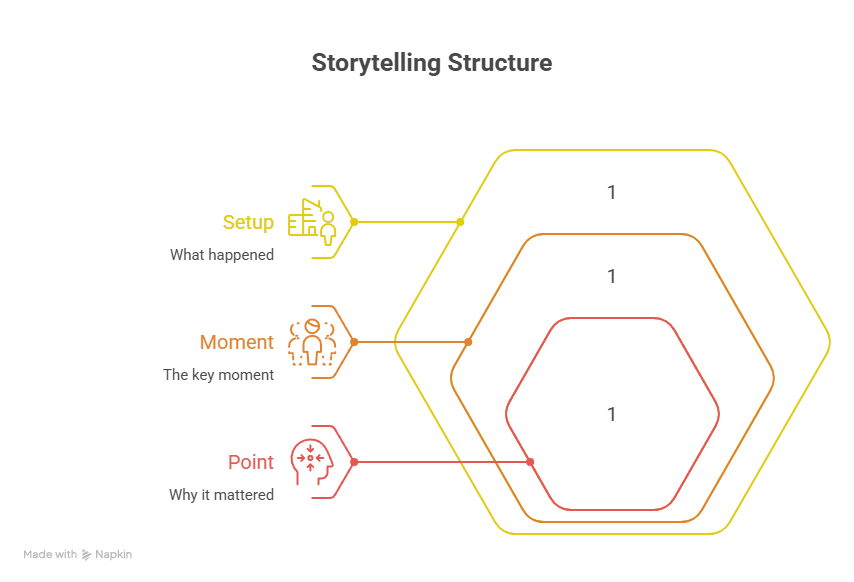
A strong story usually has three parts:
- setup
- moment
- point
That is it. If someone can picture it and understand why you told it, the story works.
Try this: Tell one story this week in three sentences:
- What happened.
- The key moment.
- Why it mattered.
8) Validation without agreement.
This is one of the most useful people skills in the world.
You can make someone feel understood without agreeing with their conclusion.
That matters because most conflict escalates when the other person feels dismissed.
Validation sounds like:
- “I can see why that would feel frustrating.”
- “That makes sense from your perspective.”
- “I get why that landed that way.”
You are validating the experience, not surrendering your view.
Try this: Replace “That’s not true” with “I can see why it looks that way from your side.”
9) Calm confidence: pacing, pauses, and simplicity.
Confidence is not just what you say. It is how you deliver it.
When people get nervous, they usually do three things:
- Talk too fast.
- Over-explain.
- Fill every silence.
Calm confidence does the opposite. It slows down, pauses, and keeps things simple. That is why grounded people often sound more authoritative without saying more.
Try this: Before answering a hard question, take one breath. Then answer in one clean sentence.
10) Playfulness and light humor.
You do not need to become a comedian. You just need a little lightness. Playfulness makes people feel more at ease. It softens interactions, lowers tension, and makes you more enjoyable to be around.
The key is not trying too hard. Short, situational, low-pressure humor works best.
Examples:
- “This coffee could wake up a bear.”
- “That question sounded better in my head.”
- “Strategic obstacle placement,” after leaving your shoes in the hallway
Try this: Make one light observation this week, then move on. Do not force it.
11) Handling awkwardness.
Awkwardness is not a social death sentence. It is just friction. The people who seem smooth are not the people who never create awkward moments. They are the people who recover quickly.
A simple recovery formula is:
- Notice it.
- Acknowledge it lightly.
- Reset the conversation.
Examples:
- “Let me try that again.”
- “I worded that badly.”
- “Okay, that came out weird.”
- “Anyway…”
Try this: Memorize three reset lines and use them instead of panicking or over-explaining.
12) Nervous system control in social moments.
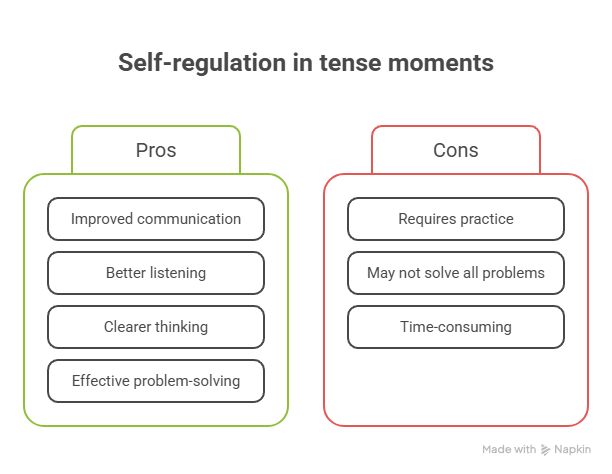
A lot of social problems are not communication problems. They are nervous system problems. When your body gets activated, your thinking narrows. Your pace speeds up. Your tone changes. Your listening gets worse.
That is why one of the best people skills is learning to regulate yourself in the moment.
Think:
- Notice
- Ground
- Re-engage
Grounding tools:
- Relax your jaw
- Drop your shoulders
- Feel your feet
- Exhale a little longer than you inhale
Try this: In your next tense moment, regulate first before trying to win the conversation.
Part 3: Hard conversations, boundaries, and influence
13) Boundaries with warmth
Unclear boundaries create more tension than clear ones.
A good boundary is:
- Clear
- Brief
- Respectful
It does not need a long explanation.
A clean formula is:
- Warmth
- Limit
- Redirect
Example:
“I appreciate you asking. That won’t work for me tonight. I can do tomorrow morning.”
That is direct, calm, and clean.
Try this: Practice one respectful no this week without over-explaining.
14) De-escalation and repair after friction.
Friction is part of every relationship. The skill is not avoiding every rupture, rather the skill is to repaire well. Most people escalate tension by defending, matching intensity, or trying to prove they were right.
A better sequence is:
- Lower your tone
- Acknowledge the frustration
- Own your part
- Reset the direction
Even taking responsibility for your 10 percent can change the entire interaction.
Try this: In your next tense moment, ask yourself, “What is my 10 percent here?”
15) Reading context: what matters in the room.
Strong communicators do not just read the person. They read the room.
Three things matter a lot:
- Status
- Stakes
- Mood
They ask these questions:
Who has influence here?
What matters most right now?
What is the emotional tone?
If you ignore context, even good communication can land poorly. If you read context well, you will seem more calibrated and more emotionally intelligent.
Try this: Before speaking in an important room, do a quick scan:
- Status
- Stakes
- Mood
Then make one small adjustment.
16) Influence in conversation: framing + contrast.
Influence is not pushing harder, rather it is shaping how something is perceived.
Two tools matter a lot here:
- Framing
- Contrast
Framing is how you position something. Contrast is what you compare it against. Same idea, different frame, different reaction.
Example:
“This costs $3,000” lands differently than “This is a $3,000 fix for a problem costing you far more than that.”
That is why influence is often less about force and more about perspective.
Try this: When presenting an idea, ask:
- What frame makes this clearer?
- What comparison makes the value more obvious?
17) Disagreement without damage.
Most disagreements become damaging when people feel misunderstood. That is why one of the best skills in disagreement is steelmanning. Steelman means you restate the other person’s view in its strongest, fairest form before responding.
Then you bridge into your view without turning the conversation into a collision.
A clean pattern is:
- “Let me make sure I have your point…”
- “The strongest version of what you’re saying is…”
- “And where I see it a little differently is…”
That keeps disagreement respectful and productive.
Try this: In your next disagreement, make the other person feel accurately understood before you make your case.
Part 4: Relationships that compound over time
18) Networking reps: entering, exiting, and follow-up.
Networking gets easier when you stop treating it like a performance.
It is just a series of social reps:
- Enter
- Connect
- Exit
- Follow up
The biggest mistakes are usually:
- Hesitating too long to enter
- Staying too long
- Never following up
You do not need the perfect opener. You need easy reps.
Examples:
- “Mind if I join you?”
- “How do you know the group?”
- “Great talking with you. I’m going to circulate a bit.”
- “Good meeting you last night. Enjoyed our conversation about…”
Try this: At your next event, do one extra conversational rep after you feel like stopping.
19) Deepening relationships: selective vulnerability + consistency.
Relationships do not deepen just because of one meaningful conversation.
They deepen when two things happen together:
- Selective vulnerability
- Consistency
Selective vulnerability means you share something real, but not everything, all at once. Consistency means you keep showing up. That combination builds trust.
Too little vulnerability keeps things shallow. Too much vulnerability too fast can feel heavy. The sweet spot is one layer deeper…then a steady follow-through.
Try this: Share one honest line with someone this week, then back it up with one steady action.
20) Your personal people-skills code.
At some point, this stops being about random tactics. It becomes about your code. Your people-skills code is your social operating system. It tells you how you want to show up when the moment gets stressful, awkward, emotional, or important.
A simple way to build it is with four layers:
- Identity
- Principles
- Behaviors
- Reps
Ask yourself:
- Who do I want to be with people?
- What principles guide me?
- What behaviors make that visible?
- What reps will help me train it?
Here is a simple example:
- Identity: grounded, warm, clear.
- Principles: regulate first, curiosity over performance, warmth before clarity.
- Behaviors: ask one better question, reflect before solving, repair quickly.
- Reps: one presence rep a day, one follow-up a week, one fast repair after tension.
Try this: Write your own people-skills code in one paragraph.
A simple weekly reps plan
If you want this post to actually change your life, do not try to master all 20 lessons at once. Pick a few reps and run them consistently.
Daily reps
- One presence rep
- One better question
- One reflect-and-confirm moment
- One moment where you slow your pace under pressure
- One clear next step in a conversation
Weekly reps
- One warm boundary
- One repair after friction
- One networking follow-up
- One moment of selective vulnerability
- One short review: what worked, what did not, what needs another rep
Final Thoughts on These People Skills
You do not need to become someone else. You do not need to become louder, slicker, or more performative. You need better defaults. You need to be a little more present. A little warmer. A little clearer. A little less reactive. A little better at repair. That is how people skills grow. Not through intensity. Through reps.