
 Joel Bein: Clearing Limiting Beliefs, The Santa Claus Effect, and a 12-Year Morning Routine
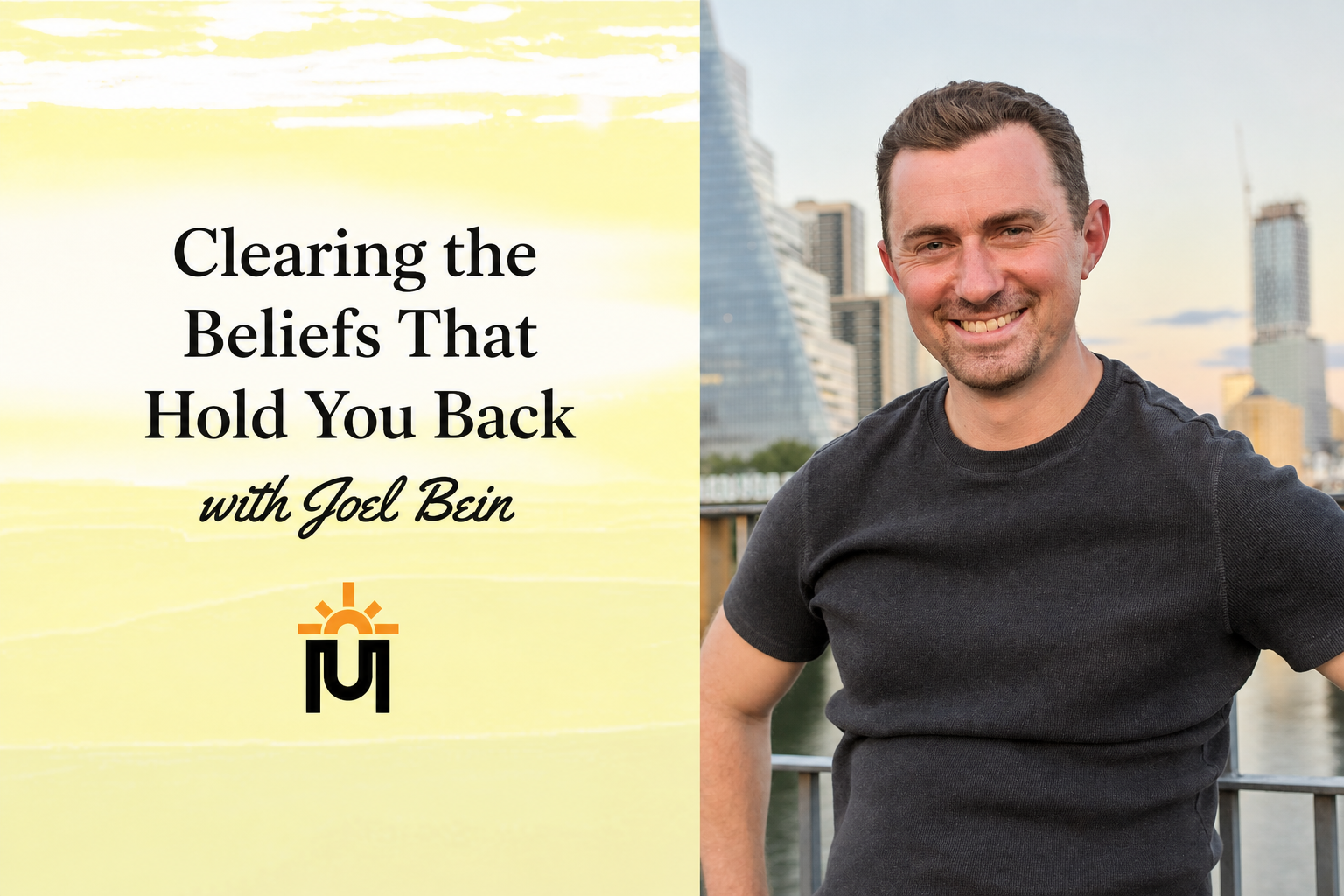
Joel Bein is the founder of Human Liberation, where he works one on one with entrepreneurs to find and clear the subconscious beliefs behind self-doubt, stress, overworking, procrastination and imposter syndrome. He also hosts The Joel Bein Show and conducts the New Orleans Chamber Players. In this episode we get into limiting beliefs, the Santa Claus effect, and a morning routine he has been refining for more than a decade.
Top Points in This Episode
- What a limiting belief actually is, and how it strings up into your thoughts, emotions, actions and outcomes
- Why most beliefs get wired in during childhood, many of them before age seven
- The one question that helps you spot a belief: “What would I have to believe for me to be experiencing this?”
- The Santa Claus effect, and why a belief you can see through does not come back
- Joel’s morning routine, built and refined over 10 to 12 years
- Why the meaning of life might be becoming who you are, plus contribution
How Joel Got Into This Work
Joel grew up in a home with plenty of fighting and dysfunction, and he built his own walls and his own inner critic along the way. Around age 19 or 20 he started asking bigger questions, which pulled him into philosophy, psychology and introspection. He went deep on personal development, worked in classical music, education and startups, and eventually landed on the work he does now: helping people unlearn the reasons behind their bad habits. As he puts it, why are we scrolling TikTok instead of doing the thing we want to do? Often it is because something underneath is uncomfortable and we are trying to numb it.
Writing Your Own Script
In his late twenties Joel was on track to become a music professor. He made a decision to stop following the conveyor belt that was handed to him and write his own story instead. His takeaway is that a good life starts with self-knowledge. Who am I, what are my values, what matters to me, what makes me come alive. Once that foundation is set, you can nurture health, relationships, creativity, purpose and impact on purpose rather than by default.
Joel’s Morning Routine
Joel has been crafting his morning routine for 10 to 12 years, and it usually runs about an hour and a half. He makes his bed first thing, drinks a big glass of water, and does about five minutes of meditation, which has been a staple for around 12 years. Then he gets outside early for sunlight and movement, some kettlebell work, feet on the grass, stretching. After that comes a shower, coffee, journaling and a walk. He finishes with creative deep work, studying music or writing, so the highest leverage project gets his best focus.
Ryan pointed out how much overlap there is with his own routine, right down to the five minute meditation, the morning walk in the sunlight and the kettlebell in the corner of the room. Ryan also shared his current experiment: an eye ice pack while he listens to something spiritual for five minutes. His kids think he is crazy. It works for him.
What a Limiting Belief Really Is
A belief is a story you see the world through, and it usually sits below the level of what you are actively thinking about. Joel uses a common one as an example: the way to be successful is to work hard. Believe that, and you will automatically produce thoughts like “I need to work harder” and the strain that comes with it. The feeling is not coming from the work. It is coming from the belief.
Most of these get installed early. Joel often asks clients where they first learned a belief like “it is not okay to fail,” and the answer is usually something like a bad grade at age 10 and a parent getting upset. For a kid, that shortcut makes sense. It protects you. Thirty years later that same program can be the reason a project never gets started.
How to Find Your Own Beliefs
Start with symptoms. The inner critic, the procrastination, the self-doubt, the stress, the reaction to the driver who cut you off. Then ask: what would I have to believe for me to be experiencing this emotion? Test a belief by dropping into it compassionately. If it lands with a weight, it is there.
The Santa Claus Effect
Once a belief is identified, Joel walks people through a Socratic question and answer process, about 15 minutes per belief, until the subconscious part holding it sees that it was never true to begin with. His example: if your dad got mad about a report card, you never actually saw “it is not okay to fail” with your eyes. You saw a face. You made the meaning.
That is the Santa Claus effect. Once you realize you never had proof and you made it up, the belief drops, and it does not come back next Christmas. Joel compares clearing beliefs to decluttering a closet full of old shirts. One at a time, and it gets lighter. He says the constant noise in his own head is about 95 percent quieter than it used to be.
On Parenting and Grace
Joel does not have kids yet, but has read dozens of parenting books and worked with kids of all ages. Ryan, with three daughters, offered the honest version: you do the best you can and it is not going to be perfect. Joel agreed. Theory and practice are different things, and you owe yourself some grace when the moment does not go ideally.
Connect with Joel
Learn more about Joel’s work and book a free deep dive call, where he will map an initial list of beliefs behind your patterns and clear one of them for you as a gift, at thehumanliberation.co.
You can also listen to his podcast, The Joel Bein Show, or visit his personal site at joelbein.com.