
 Gideon Enok on How Walking 3,500 Km Across Europe Changed His Life
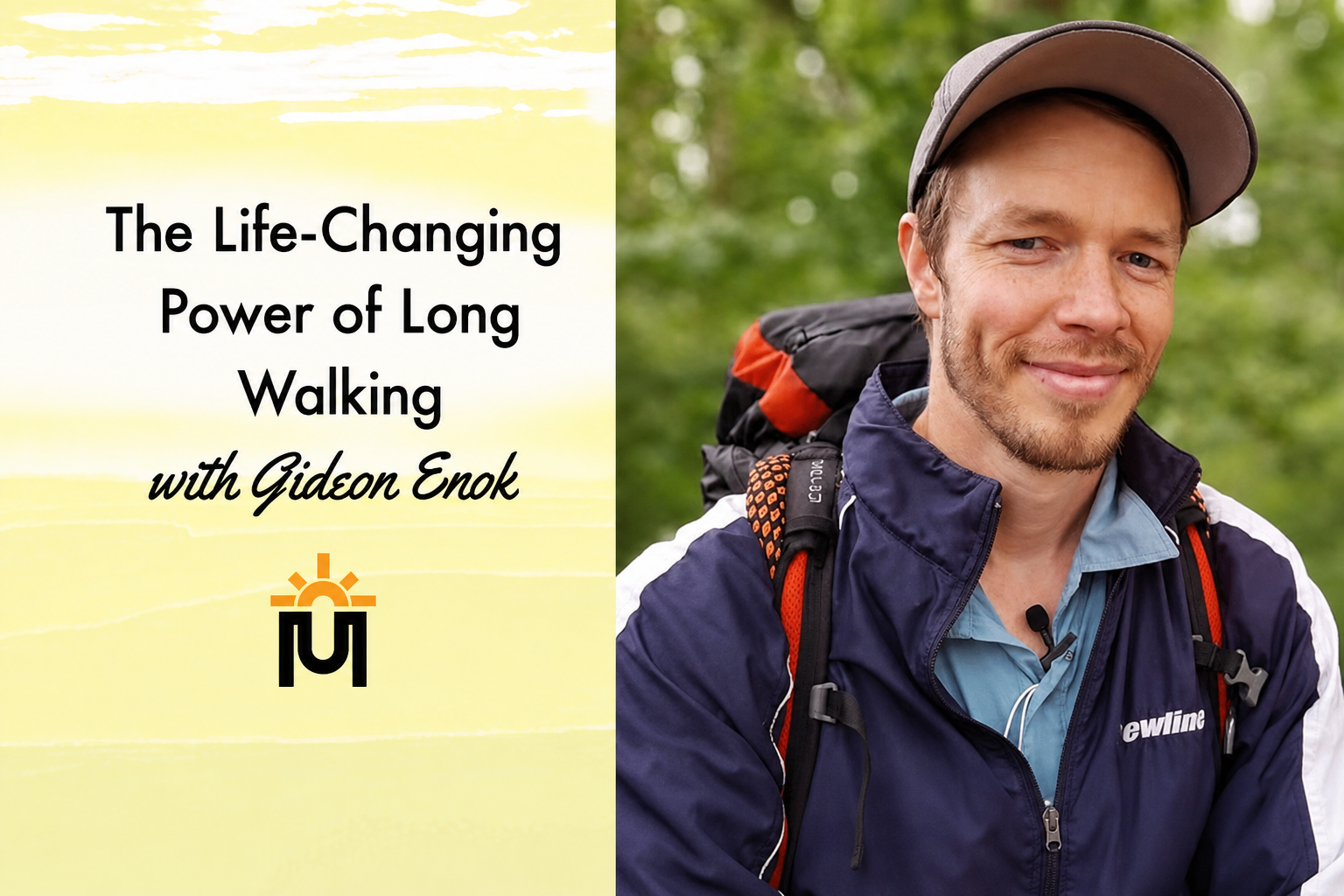
In this episode, I sit down with Gideon Enok, a Danish traveler, writer, and author of the new memoir The Pilgrim Spirit. Gideon has completed five long-distance walks covering over 7,000 kilometers, and his longest was a solo, five-month trek from Denmark to Santiago de Compostela during the 2020 pandemic. We talk about what it’s really like to walk that far, how the experience changed him from the inside out, the three phases every long-distance walker goes through, and why he believes this kind of slow, simple practice can do more for personal growth than almost anything else.
Top Points in This Episode
- Gideon walked 3,500 km through five countries over five months, completely solo, after hearing a mysterious inner voice calling him to start
- Long walks work in three phases: physical (adjusting to the pain), mental (facing your emotions), and spiritual (reconnecting with yourself)
- Day 79 was the most physically painful day of Gideon’s life, and it planted the first seeds of forgiveness toward his family
- His writing mentor, Gregory David Roberts (author of Shantaram), taught him one of the biggest lessons of his life: write with humility
- The Camino has been walked for over 1,000 years, and Gideon says there’s a real energy on the path that you can feel
- You don’t need a clear reason to start walking. Gideon says you often receive what you didn’t know you needed
Gideon’s Morning Routine
Gideon keeps it simple. Right now he’s back in Denmark, staying at his dad’s house and taking care of the family dog. His morning starts with a walk outside with the dog. That’s it. Getting outside, getting steps in, breathing fresh air. It runs in the family too, as his dad was off on his own walk when we recorded this episode.
Why He Wrote The Pilgrim Spirit
The book came out of Gideon’s five-month walk from Denmark to the northwest coast of Spain in 2020. He says the pull of the walk was so strong that looking back at his own YouTube footage, he sometimes couldn’t believe he actually did it. Writing the memoir was a therapeutic process. It forced him to look at his experiences with perspective, forgiveness, and acceptance instead of the judgmental lens he grew up with. Working with his mentor, Gregory David Roberts, pushed him to write with humility, and that lesson alone changed how he sees other people.
The Moment That Started Everything
Gideon was stuck. He had just gone through a breakup, felt frustrated and tired of his situation, and moved to a red farmhouse in the middle of nowhere. On the 30th morning of that funk, he was completely fed up. He sat down and meditated for three hours, then walked out to the ocean. Standing there on a calm, sunny day, he heard a clear voice: “Why don’t you walk from Denmark to Santiago, Gideon?” Nobody was there. Two weeks later, he started walking with no real understanding of why. He still can’t fully explain it.
The Three Phases of the Camino
Gideon breaks down the long walking experience into three phases:
Phase 1: Physical. The first 10 to 15 days are about getting used to walking 10, 15, or 20 miles every day. It’s hard. You have to push through the soreness and build your physical foundation before anything deeper can happen.
Phase 2: Mental. Once your body adjusts, the real work begins. This is where suppressed emotions, old frustrations, and unresolved pain start surfacing. On the French Way of the Camino, this often happens in the Meseta, a flat, open stretch between Burgos and Leon where there’s nothing to distract you. You’re forced to look at yourself.
Phase 3: Spiritual. After shedding those mental and emotional layers, something shifts. You start feeling more connected to yourself, to the people around you, and to the experience itself. The slow pace of walking is what makes it stick. You let go of things slowly, and you gain new things slowly, so the changes stay with you after the walk is over.
Day 79 and Learning to Lean on Himself
Gideon describes Day 79 as the most physically painful day of his life. But that extreme pain narrowed his focus down to one thing: his steps. He literally counted “one, two, one, two” because that was all he could do. His brother had told him before the trip, “You need to learn to lean on yourself without being dependent on anybody or anything outside of yourself.” In that moment of intense pain, Gideon finally understood what that meant. He had nothing but his own two feet. And that foundation, he says, is something you carry with you for the rest of your life.
That same day also cracked open something he had been holding onto for years. The pain helped him see where his resistance toward authority figures, his parents, and his grandparents was really coming from. It planted the first seed of forgiveness.
The Kindness of Strangers in Belgium
One of Gideon’s most memorable moments came in a mountain village in Belgium. He hadn’t planned ahead, arrived late, and there was no hostel, no bed and breakfast, nothing open. It started raining. He ended up sitting in a bus stop in the dark, repeating to himself, “There’s nothing I can do now.” When he finally surrendered to that, something almost miraculous happened. A man saw him from across the road, made a phone call, and drove Gideon to his home. He and his wife gave Gideon food, a room, and a packed lunch for the next morning. They had already left for work when he woke up. That kind of open-hearted generosity, Gideon says, is something you experience often when you’re out there as a pilgrim.
His Advice for Anyone Thinking About the Camino
Gideon recommends starting with the traditional French Way of the Camino, which runs about 500 miles (800 km) from the French border across northern Spain to Santiago de Compostela. He suggests walking in April or September to avoid the summer crowds. Over 1,000 years of pilgrims have walked that path, and there’s a special energy there that’s hard to describe until you feel it. His biggest pitch for doing it: walking is the most human, basic, and grounding thing you can do. It reconnects you with yourself, with the earth, and in a way, with your ancestors. The Latin root of the word “humble” actually means “on the earth,” and that’s exactly what a long walk is.
Connect with Gideon
- Website: thepilgrimspirit.com (read the first chapter of the book for free)
- Book: The Pilgrim Spirit is available on Amazon