
 20 Decision Making Lessons for Uncertain Times
IIn unpredictable times, making decisions can feel like walking a tightrope in the dark. You might not have all the facts, and outcomes are never guaranteed. However, great decision makers aren’t born – they’re made through practice and the right mindset. Below we’ll explore 20 hard won lessons to help you navigate uncertainty with confidence and clarity. These lessons blend insights from business leaders and cognitive science to offer a practical, conversational guide you can actually use. Let’s dive in!
20 Lessons for Decision Making Under Uncertainty
1. Anchor Your Decisions in Core Values
When everything around you is changing, your core values act as a compass. By grounding choices in your fundamental principles, you ensure consistency and integrity even when the future is murky. Not only do value driven decisions feel more authentic, they also rally your team’s support people trust leaders who walk the talk. In short, when in doubt, fall back on what matters most to you and the mission.
2. Communicate Transparently (Especially During Chaos)
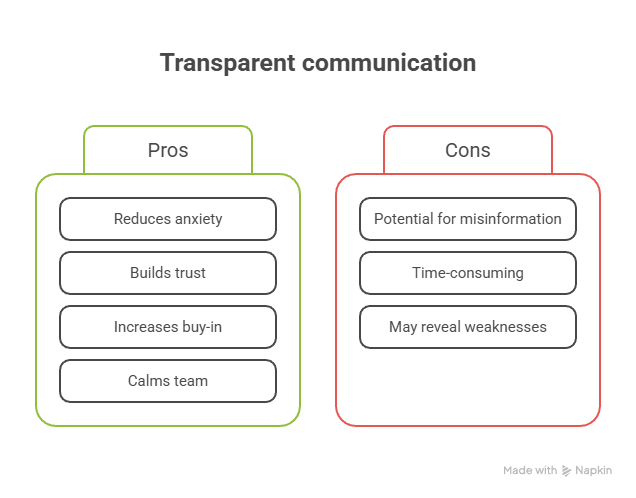
Uncertainty can breed anxiety. The antidote? Communication, communication, communication. Be open about what is known and what isn’t. Share your thought process and invite questions. When you keep your team informed, you replace rumor and fear with trust. Transparent decision making also earns you buy in people are more likely to follow plans they understand. Remember, silence is not calm; honest updates, even with imperfect information, are calming.
3. Embrace Imperfection – Don’t Chase the “Perfect” Decision
In an ideal world, we’d have all the data and endless time to decide. Reality laughs at that. Perfect is the enemy of good when decisions are time sensitive. High achievers often struggle with this, but under uncertainty, it’s crucial to accept that no option will be flawless. Aim for a “good enough” decision that you can refine as you go. Letting go of perfectionism frees you to act faster and learn from the results, instead of being paralyzed waiting for certainty.
4. Adopt a People Centric Mindset
Behind every decision are people – your team, customers, family, or community. Especially in uncertain times, factor in the human element. Consider how choices impact morale and stress levels. Engage others in the process where you can; it makes them feel valued and brings in diverse perspectives. A people first approach (some call it servant leadership) means you’re not just making choices in a vacuum – you’re empowering those around you. Ultimately, taking care of your people will pay off in better execution of whatever decision you make.
5. Know that Good Decisions Can Lead to Bad Outcomes (and Vice Versa)
One tough lesson of life (and poker, as champion Annie Duke notes) is that the quality of a decision isn’t the same as the quality of its outcome. You can do everything right given the information at hand and still have things go sideways. Conversely, you might wing it and luck out sometimes. In uncertain environments, separate your decision process from the result. Judge your choices by whether they were sound at the time, not just by hindsight. This mindset will help you learn and improve without dwelling on unpredictable outcomes.
6. Treat Decisions as Bets – Think in Probabilities
Every choice is essentially a bet on a future state of the world. Since we’re dealing with probabilities, not certainties, start viewing your decisions through a “bets” lens. Ask yourself: What are the odds this option succeeds? By embracing probabilistic thinking, you acknowledge uncertainty rather than ignoring it. This doesn’t mean gambling recklessly; it means weighing options like a savvy bettor. Over time, this habit of thinking in terms of likelihoods helps you avoid overconfidence and consider alternative outcomes before you commit.
7. Continuously Calibrate Your Beliefs
Our decisions are only as good as the beliefs and assumptions we base them on. Under uncertainty, many of those beliefs will later prove incomplete or even wrong. Get comfortable with updating your thinking as new information arrives. In practice, this means staying curious and adaptable. Seek out disconfirming evidence: ask, “What would change my mind?” When the world shifts, be willing to shift your stance. Strong decision makers hold their convictions firmly but provisionally. They update their maps as soon as they realize something new – and that’s a skill worth practicing.
8. Beware of Cognitive Biases (Your Brain’s Hidden Traps)
Even the sharpest minds have blind spots. Common cognitive biases – like anchoring, confirmation bias, or the illusion of control – can skew our reasoning without us realizing it. For example, you might give too much weight to the first piece of information you received (anchoring), or only notice facts that confirm your pre existing view (confirmation bias). The best defense is awareness. Before finalizing a decision, take a step back and question your thinking: “Am I being objective, or am I tricking myself here?” Consider getting input from someone who has a different perspective to spot your biases. You can’t eliminate these mental shortcuts (they’re human!), but you can manage them by shining a light on them.
9. Use “I’m Not Sure” to Your Advantage
Admitting uncertainty is not a weakness – it’s a superpower. Saying “I don’t know” or “I’m not sure” when appropriate keeps you honest and opens the door to learning. It encourages you to gather more information or consult with others who might know more. By contrast, false certainty can lead to stubbornly sticking to a plan that isn’t working. Embracing the phrase “I’m not sure” reminds both you and others that you’re operating in a gray zone and that adaptability is key. Paradoxically, being frank about what you don’t know can increase your credibility; people trust a leader (or friend) who is realistic over one who pretends to have all the answers.
10. Gauge Your Confidence Level – Don’t Settle for “Confident/Not Confident”
When making a call in uncertainty, it’s helpful to think in shades of confidence rather than a binary “yes I’m sure” or “no clue.” For instance, are you 60% confident in that sales forecast? 80%? This habit forces you to be more precise about your uncertainty and can guide how much risk to take. If you realize you’re only 50% confident, maybe that’s a sign to gather more data or hedge your bet. If you’re 90% confident, you might proceed but still keep an eye on that 10% chance of being wrong. Expressing confidence as a spectrum also communicates nuance to others (“I’m fairly confident this will work, but here are the potential pitfalls…”). Over time, comparing your confidence estimates to how things actually turn out will improve your calibration as a decision maker.
11. Map Out Possible Outcomes (and Their Probabilities)
One way to wrestle uncertainty to the ground is to spell out the different ways a decision could play out. What’s the best case scenario? The worst case? And what’s likeliest in the middle? By envisioning multiple futures, you avoid tunnel vision and prepare yourself for surprises. If you can, assign rough probabilities to each scenario (even if it’s just high/medium/low likelihood). This exercise forces you to confront uncertainty head on. For example, if there’s a 20% chance a project fails, what will you do? Can you live with that risk? Thinking in this way helps ensure you’re not blindsided and can prompt contingency plans for the more worrisome outcomes.
12. Don’t Equate Decision Quality with Outcome Quality
Hindsight is 20/20 – and dangerously misleading. It’s tempting to judge a decision solely by whether it worked out. But as we discussed earlier, good choices can have bad outcomes due to factors outside your control (luck, market swings, freak events). The reverse is also true. This is why it’s crucial, especially in uncertain conditions, to avoid hindsight bias. Instead, conduct a premortem: evaluate a decision on the process and rationale before the outcome is known. Ask, “Did I consider the relevant information? Did I weigh pros and cons rationally? Was I thinking clearly?” If yes, then it was a good decision, outcome aside. Separating these things keeps you learning the right lessons instead of drawing false comfort or undue blame from results that were essentially a roll of the dice.
13. Seek Feedback and Outside Perspectives
Don’t go it alone in the fog. When uncertainty is high, two (or five) heads are often better than one. Run your thinking by trusted colleagues, mentors, or friends. They might catch flaws you missed or validate that you’re on the right track. Encourage honest feedback – sometimes a healthy debate can reveal aspects of the problem you hadn’t considered. Also consider diverse perspectives: if everyone around you thinks the same way, you might all be missing the same key piece of insight. You can even create a personal “decision council” informally. By bouncing ideas off others, you not only reduce your blind spots, you also gain confidence (or a reality check) in the choice you’re about to make.
14. Analyze Decisions in Advance, Not Just in Retrospect
We often wait until after the fact to dissect a decision (“What went wrong? What went right?”). But analyzing before you decide can be even more powerful. One technique is the “premortem” – imagine it’s months later and your decision ended in disaster; now brainstorm what could have led to that. By doing this, you might identify risks or weak assumptions you can address now. Another approach is scenario planning: play out how you expect things to unfold step by step. The goal isn’t to predict the future perfectly (impossible!), but to illuminate the decision path while you still have the chance to adjust it. Think of it like a rehearsal for your choice – it can greatly improve the performance when the real moment comes.
15. Consider Your Future Self
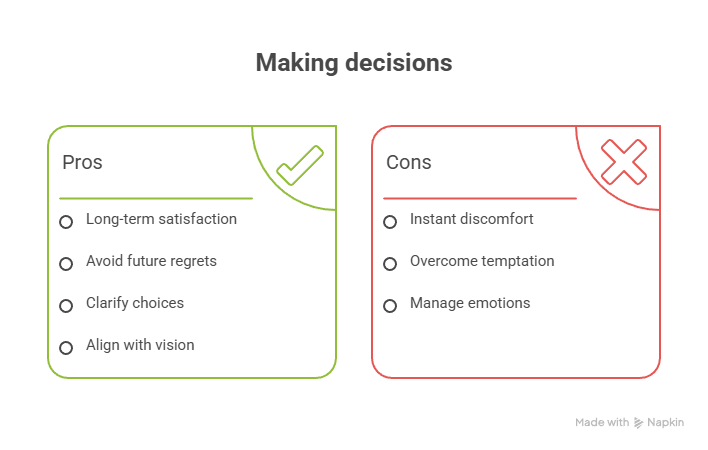
Decisions made solely for instant comfort often become tomorrow’s regrets. To make better long term choices, time travel in your mind. Project yourself into the future – a year, five years, ten years down the road – and imagine looking back at today. Will you be proud of this decision later? What would Future You wish you had done? This perspective can cut through some of the short term noise (emotions, peer pressure, temptation to procrastinate) and clarify the more enduring choice. For example, staying in your comfort zone might feel safe now, but will you kick yourself later for not taking that calculated risk? Align decisions with the vision you have for your life or business in the long haul. Your future self will thank you.
16. Work Backward from Your Goal (Premortems and Backcasting)
Another forward thinking trick is backcasting – start by envisioning a successful outcome, then reverse engineer how you got there. This flips the usual process. Instead of asking “What do we do next?”, first define what success looks like, then plot the steps in reverse order that would lead to it. This can highlight milestones and requirements you might otherwise overlook. Similarly, do a premortem for failure: assume the decision fails and ask “Why did it happen?” Identifying potential failure points in advance allows you to build safeguards or choose a different path entirely. Together, these backward looking exercises ensure you aren’t just wandering forward with fingers crossed – you’re proactively designing your journey through uncertainty with a destination in mind.
17. View Uncertainty as an Opportunity, Not a Threat
It’s human nature to fear the unknown, but uncertainty also opens space for innovation. When you don’t have a preset map, you’re free to draw new paths. Great breakthroughs often happen in uncertain times because people are forced to get creative. Try shifting your mindset: instead of thinking “What if everything goes wrong?”, ask “What new possibilities exist because things are so open ended?” This lesson is about embracing a bit of adventure. If Plan A isn’t guaranteed, maybe it’s time to consider Plan B, C, or a whole new alphabet. Uncertainty can be a catalyst that pushes you to experiment and iterate quickly. Leaders who thrive in chaos are often those who see it as a feature, not a bug – an environment where fresh ideas can flourish and old assumptions can be left behind.
18. Stay Agile: Decide, Act, and Iterate
In rapidly changing conditions, lengthy deliberation can be a luxury you can’t afford. Sometimes the better approach is small decisions and quick iterations. Think of it like sailing: you constantly adjust course rather than setting a fixed direction once and for all. Start with a decision that seems best based on what you know (observe, orient, decide, act), then pay attention to the results and feedback. If needed, adjust and decide again. This agile approach (in line with the OODA loop concept) prevents you from waiting too long for perfect insight and helps avoid massive overcommitment to a single plan. By taking action and learning in short cycles, you remain flexible. Essentially, you’re feeling your way forward, course correcting as new information emerges. In uncertain times, many small course corrections beat one big shipwreck.
19. Avoid Analysis Paralysis
Have you ever overthought a decision to death and missed an opportunity? Under uncertainty, it’s easy to fall into analysis paralysis – endlessly gathering data or second guessing every choice. While research and caution have their place, beware of diminishing returns. Set yourself a decision deadline or a clear threshold for “enough” information. One trick is to identify the top few variables that will likely drive the outcome, focus on those, and accept that minor details might remain fuzzy. Another tip: consider the cost of not deciding. Often, making no decision is actually worse than choosing an imperfect option, because it means zero progress. Remember, you can usually adjust your course later (as Lesson 18 encourages), but you can’t steer a parked car. Do your homework, trust your reasoning, then take the leap.
20. Commit to Continuous Learning
Every decision, whether it succeeds or flops, is valuable if you learn from it. In uncertain environments, adopting a learning mindset is vital. After each major decision, take time to reflect: What went well? What surprised you? What would you do differently next time? Encourage your team to do the same and share insights. By treating decisions as experiments with feedback, you gradually turn uncertainty into an advantage – each outcome teaches you something about how the world works (or doesn’t!). Over time, patterns emerge, your intuition sharpens, and your “decision muscle” strengthens. Continuous improvement turns you into an increasingly confident decision maker. Uncertainty will always be there, but you’ll handle the next wave with more skill and wisdom than the last.