
 20 Sales Lessons for Entrepreneurs: How to Sell with More Clarity, Trust, and Less Pressure

A morning upgrade is not just about what you do before breakfast.
It is about how you show up.
When you start the day with intention, you think better. You react less. You listen more. You bring a calmer version of yourself into your work, your relationships, and your business.
And one place this really shows up is sales.
I know a sales article may seem a little different for Morning Upgrade, but I actually think it fits perfectly.
Morning Upgrade is about personal development, morning routines, entrepreneurship, mindset, habits, and becoming a better version of yourself. And if you run a business, lead a team, pitch ideas, manage clients, or try to move anything forward, you are selling all the time.
You are selling trust.
You are selling clarity.
You are selling a better future.
You are selling the idea that you can help.
That is why sales is not just a business skill. It is a personal development skill.
It tests your patience. It tests your confidence. It tests your listening. It tests your ability to stay calm when someone says no, ghosts you, questions your price, or pushes back.
A lot of the same ideas I talk about in my morning routine guide apply directly to selling. Start with intention. Know your priorities. Do not begin the day reactive. Create space to think. Show up with more clarity.
That same approach can make you better at sales.
This also connects to the idea behind The Perfect Day Game Plan for Entrepreneurs. A strong day does not happen by accident. It happens when you are intentional with your energy, focus, habits, and decisions.
Sales works the same way.
Good sales is not about tricks.
It is not about pressure.
It is not about saying the perfect line.
It is about becoming the type of person who can guide a conversation with calm confidence, ask better questions, listen for what matters, and help someone make a good decision.
So below are 20 sales lessons for entrepreneurs, service providers, and business owners who want to sell in a more human, grounded, and high-trust way.
You can read this straight through or skim the lessons that apply most to where you are right now.
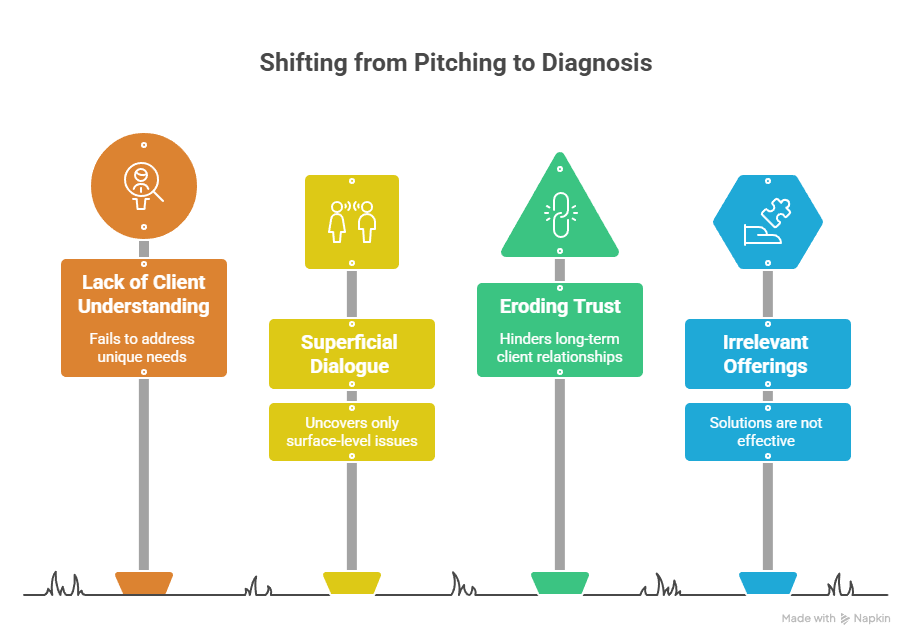
1. What Selling Services Actually Is: Diagnosis, Not Pitching
Selling services is not mainly about convincing someone to buy.
It is about diagnosis.
That means your first job is not to explain everything you do. Your first job is to understand what is really going on.
A lot of people make the mistake of jumping right into the pitch.
They hear a prospect say, “We need more leads,” and they start talking about SEO, ads, content, email marketing, or whatever service they sell.
But “we need more leads” is usually only the surface problem.
The real problem may be poor positioning. It may be a weak website. It may be bad follow-up. It may be the wrong audience. It may be a trust issue. It may be a sales process issue.
You do not know yet.
That is why diagnosis matters.
Before you recommend anything, slow down and understand the situation.
Ask questions like:
What made you start looking for help now?
What is not working the way you want?
What have you already tried?
What do you think is causing the problem?
What would a successful outcome look like?
This is where trust starts.
People do not want to feel pitched. They want to feel understood.
This connects to personal development because it requires patience and self-control. You have to manage the urge to prove yourself too quickly.
The better move is to listen first.
Simple reminder: Diagnose before you prescribe.
2. Trust Before Tactics
Tactics matter.
But trust matters first.
Your strategy, services, pricing, case studies, and proposal will not land well if the prospect does not trust you.
Trust is built when the prospect feels three things:
You understand me.
You are telling me the truth.
You are not trying to force me.
That is it.
A lot of salespeople try to build trust by talking more. They explain more. They list more credentials. They send more proof. They try to sound impressive.
But trust often comes from the opposite.
It comes from calmness.
It comes from honest questions.
It comes from saying, “I am not sure that is the right move yet.”
It comes from being willing to recommend a smaller first step if that is what makes sense.
People can feel when you are trying too hard to close them.
They can also feel when you are actually trying to help.
That is why trust before tactics is so important.
If you want to improve your people skills in general, this lesson also ties closely to 20 People Skills Lessons to Improve Communication. Sales is communication under pressure. The better you are with people, the better you will sell.
Simple reminder: Be useful before you try to be persuasive.
3. Knowing Your Buyer: Owner, Marketer, Operator
Not every buyer cares about the same things.
This is a big one.
You may be selling the same service, but the buyer hears your message through their own lens.
An owner is usually thinking about growth, return, risk, trust, and whether the investment is worth it.
A marketer is usually thinking about strategy, quality, positioning, channels, content, and whether your thinking is sharp.
An operator is usually thinking about process, communication, timelines, handoffs, and whether working with you will be smooth or painful.
Same service.
Different buyer.
Different priorities.
If you explain your service the same way to everyone, you will miss.
For example, if you are talking to an owner, you may want to connect the work to qualified leads, growth, risk reduction, and better use of budget.
If you are talking to a marketer, you may want to talk more about strategy, positioning, content, and how the work fits into the bigger picture.
If you are talking to an operator, you may want to focus on process, communication, expectations, and how the work will stay organized.
This is not about being fake.
It is about being relevant.
Strong salespeople translate their message into the buyer’s world.
Simple reminder: Same service, different lens.
4. Discovery Questions That Uncover Real Pain
Most sales calls stay too surface level.
The prospect says:
We need more leads.
Our website is not working.
We are looking for help with marketing.
We want to grow.
Those statements are useful, but they are not enough.
You need to uncover the real pain.
Real pain has weight to it. It is not just a mild interest. It is a problem that is costing something.
That cost might be money, time, missed opportunities, frustration, wasted effort, or slow growth.
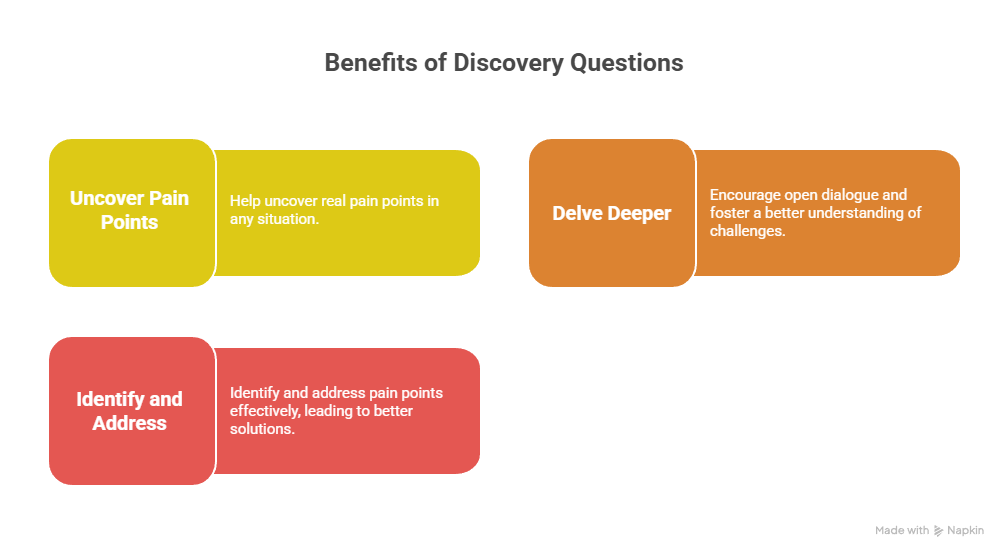
Good discovery questions help the prospect move from vague to specific.
Instead of just asking, “What do you need help with?” ask:
Where exactly is this breaking down?
How long has this been happening?
What is this costing you?
What happens if nothing changes?
How frustrating has this been?
What made this important now?
These questions help the prospect think more clearly.
They also help you understand if there is real urgency or just casual interest.
This is where sales becomes less about pitching and more about helping someone see their situation clearly.
Simple reminder: Surface answers do not create strong sales conversations.
5. Listening for Pain, Cost, Urgency, and Desire
Asking good questions is only half the job.
The other half is listening.
And not just normal listening.
You need to listen for signals.
The four big signals are:
Pain: What hurts?
Cost: What is it costing?
Urgency: Why now?
Desire: What do they want instead?
Prospects often reveal these things in casual comments.
They may say:
“We are tired of wasting money.”
“We keep getting the wrong type of leads.”
“We know this is holding us back.”
“We need to figure this out before next quarter.”
“We just want something more consistent.”
Those lines matter.
Do not rush past them.
Pause and explore them.
If someone says, “We are tired of wasting money,” you can say:
“That makes sense. When you say wasting money, where do you feel that the most?”
If someone says, “We need better leads,” you can ask:
“What would make a lead qualified from your perspective?”
The best salespeople do not just hear words. They hear meaning.
Simple reminder: Listen for the buying signals underneath the words.
6. Positioning the Problem Clearly
A lot of prospects feel the problem before they can explain it clearly.
They know something is off.
They know results should be better.
They know they are frustrated.
But the problem is still blurry.
Your job is to help make it clear.
That is what positioning the problem means.
You take what they said and turn it into a clear diagnosis.
For example, a prospect may say:
“We are getting traffic, but not many leads.”
A weak response is:
“Okay, we can help with that.”
A stronger response is:
“It sounds like the issue is not just traffic. You are already getting some attention. The bigger problem may be that the website is not building enough trust or making the next step clear enough, so the traffic is not turning into qualified inquiries.”
That is a much stronger sales moment.
You are not just repeating their words.
You are helping them see the problem more clearly.
And clarity creates authority.
This connects with decision-making too. The better you define the problem, the better the decision becomes. I wrote more about that kind of thinking in 20 Decision Making Lessons for Uncertain Times.
Simple reminder: A clear problem makes the solution feel more logical.
7. Selling Outcomes, Not Deliverables
People do not really buy deliverables.
They buy outcomes.
They do not want blog posts just to have blog posts.
They want more visibility, trust, traffic, leads, and authority.
They do not want a new website just to have a new website.
They want a website that makes them look credible and helps turn visitors into opportunities.
They do not want monthly reports just to have reports.
They want clarity and confidence about what is happening.
This is one of the biggest shifts in selling services.
Do not only talk about what you do.
Talk about why it matters.
A weak explanation sounds like this:
“We provide SEO, content, reporting, and website optimization.”
A stronger explanation sounds like this:
“We help your website become a stronger source of qualified opportunities by improving visibility, trust, and conversion.”
The second version is more powerful because it connects the work to the result.
Deliverables are the vehicle.
Outcomes are the destination.
Simple reminder: Do not sell the menu. Sell the result.
8. Differentiation Without Trashing Competitors
It is tempting to differentiate by criticizing competitors.
You might want to say:
Most agencies are terrible.
Other companies do cookie-cutter work.
Your last vendor probably had no idea what they were doing.
But that often backfires.
It can make you sound defensive, insecure, or negative.
There is a better way.
Differentiate through clarity, not criticism.
You can say:
“There are different ways to approach this. Some firms focus heavily on activity and deliverables. We tend to start with diagnosis and priorities first, so the work is tied to the highest-impact opportunities.”
That creates contrast without attacking anyone.
You are not saying others are bad.
You are saying your approach is different.
That feels more mature and more trustworthy.
A strong contrast has three parts:
Their way: one valid approach.
Your way: how you approach it.
Why it matters: what the client gains from the difference.
This helps the buyer understand you without feeling like you are throwing mud.
Simple reminder: Contrast is stronger than criticism.
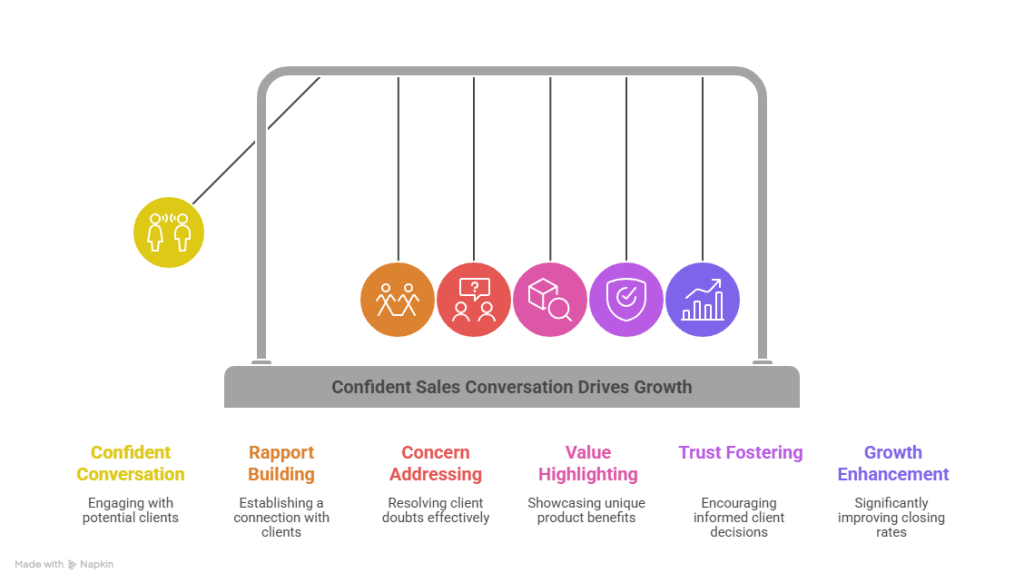
9. Leading the Sales Conversation With Confidence
Confidence in sales does not mean talking more.
It means leading the conversation.
A confident salesperson does not dominate the call.
A confident salesperson guides the call.
That means you help set the agenda. You ask the next useful question. You slow things down when needed. You summarize what you heard. You keep the conversation from drifting.
This is important because many prospects do not know how to buy your service.
They may not know what information you need.
They may jump to price too early.
They may focus on random details.
They may ask for a proposal before the problem is clear.
Your job is to guide them.
That might sound like:
“I am happy to talk about pricing. Before I do, I want to make sure I understand the situation well enough to recommend the right scope.”
That is leadership.
Not pressure.
Not avoidance.
Just a clean process.
If you struggle with confidence, sales is a great training ground. It forces you to practice calm direction. This also connects to leadership, which I covered in 20 Leadership Lessons for Men.
Simple reminder: Let the prospect talk, but you steer.
10. Presenting Recommendations Simply and Clearly
A good recommendation can still fail if it is presented poorly.
This happens a lot.
You may understand the problem. You may have a smart plan. But if you explain it in a scattered way, the prospect gets overwhelmed.
Clarity matters.
Your recommendation should answer four things:
What is the problem?
What should happen first?
Why is this the right move?
What happens next?
That is the basic structure.
Do not dump every possible idea on them.
Do not list every service.
Do not bury the main point.
A strong recommendation sounds like:
“Based on what you shared, I would not start with everything. The biggest issue seems to be that the site is not turning enough attention into qualified inquiries. So I would start by tightening the core pages and conversion path first. The reason is that more traffic will not help much if the site is still leaking trust and action.”
That is simple.
It is clear.
It shows judgment.
Simple reminder: Clear recommendations feel like relief.
11. Handling Price and Budget Objections
When someone says, “That feels expensive,” do not panic.
Also, do not immediately discount.
A price objection is not always about the price.
Sometimes it means:
I do not see enough value yet.
I am afraid this will not work.
The scope feels too big.
This is not urgent enough.
The budget timing is hard.
I need to understand the return better.
That is why curiosity matters.
Instead of defending the price, ask a clarifying question.
You might say:
“When you say it feels high, is that more about the total investment, the scope, or wanting more confidence in the value?”
That question slows things down.
It helps reveal the real issue.
If the scope feels too heavy, you may not need to discount. You may need to reduce the first phase.
You can say:
“If the full scope feels heavy right now, I would rather narrow the first phase than force a plan that does not fit.”
That keeps your value intact while still being flexible.
Simple reminder: Clarify before you discount.
12. Handling Timing Objections and “Not Now”
“Not now” is not always a no.
But it is not always a real future yes either.
It can mean many things.
It can mean:
The problem is real, but urgency is weak.
The budget window is bad.
The team is overwhelmed.
They need internal buy-in.
The scope feels too big.
They are avoiding a direct no.
Your job is to understand what kind of “not now” it is.
You can ask:
“When you say the timing is not right, is that more about budget, bandwidth, internal alignment, or the priority level?”
That question helps you separate real timing from vague avoidance.
If it is a real timing issue, you can set a clear checkpoint.
If it is a scope issue, you can discuss a smaller first phase.
If it is weak urgency, you may need to step back.
The key is not to chase every “not now” like it is a hot opportunity.
Some are real.
Some are not.
Simple reminder: Find out what “not now” really means.
13. Handling Ghosting and Stalled Deals
Ghosting is frustrating.
You have a good call. They seem interested. They ask questions. Maybe they even ask for a proposal.
Then nothing.
No reply.
No decision.
No movement.
A lot of salespeople respond by chasing harder.
They send “just checking in” emails. They call repeatedly. They ask if there are any questions. They try to stay visible.
Sometimes that works.
Often it does not.
Ghosting usually means momentum broke.
The problem may still be real, but something interrupted the movement.
Maybe the next step was vague.
Maybe the decision-maker was not involved.
Maybe urgency was weak.
Maybe the proposal created more thinking instead of action.
Maybe they are uncomfortable saying no.
Strong follow-up does not chase blindly.
It reconnects to the problem and invites honesty.
You can say:
“Based on our conversation, it seemed like the main issue was inconsistent lead flow and a website that was not converting as well as it should. Is that still an active priority, or has timing shifted?”
That is much stronger than:
“Just checking in.”
Simple reminder: Do not chase silence forever. Reconnect, clarify, then move on if needed.
14. Commitment Tests Before the Proposal
Interest is easy.
Commitment is different.
A prospect can say:
“Send something over.”
“Can you price this out?”
“Put together a proposal.”
That sounds like momentum, but it may just be easy interest.
If you send a proposal too early, the deal can drift fast.
The proposal gets reviewed later.
Questions go unanswered.
Objections get hidden.
Follow-up becomes awkward.
That is why you need commitment tests.
A commitment test is a small next step that shows the prospect is actually engaged.
Examples:
Booking the proposal review call before you send the proposal.
Confirming who is involved in the decision.
Getting a realistic start window.
Asking for a small access step, if appropriate.
Agreeing on what a yes or no will be based on.
This is not about pressure.
It is about protecting momentum.
One of the best rules you can create is:
No proposal gets sent without a review call on the calendar.