
 How to Build a Gratitude Practice That Actually Changes Your Life
In a Nutshell
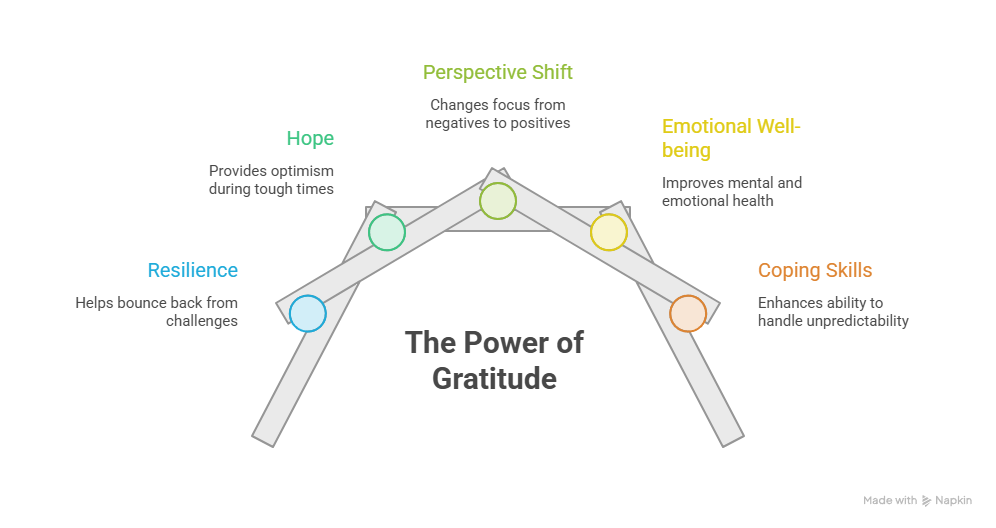
Gratitude is not about pretending life is easy, lowering your standards, or forcing yourself to be positive. At its best, gratitude is a practical way to train your attention. It helps you notice what is still good, valuable, meaningful, and worth protecting, especially when life feels stressful or unfinished.
The main idea is simple: you can be grateful for what is here and still be responsible for what comes next. Gratitude can help you stay present with your family, handle stress with more steadiness, lead your team with a better tone, think about money without panic, and take care of your health from a place of respect instead of criticism.
This is not about becoming passive. It is about becoming less blind. Stress, ambition, comparison, and familiarity can all narrow your view. Gratitude widens it again.
Why Gratitude Deserves More Respect
A lot of people hear the word gratitude and immediately tune out. It can sound soft. It can sound fake. It can sound like something people talk about only when life is already going well.
But real gratitude is not denial. It is not acting like problems are not real. It is not saying everything is great when your marriage feels tense, your finances feel tight, your business feels heavy, or your mind is racing.
Real gratitude is the ability to hold two truths at once. There is more you want to build, improve, fix, and figure out. There is also already a lot here worth valuing.
That second truth matters. When you lose sight of what is already good, your whole life starts to feel like a gap. You become someone who is always chasing, fixing, comparing, worrying, and waiting. Gratitude does not remove your problems. It reminds you that your problems are not the whole story.
Gratitude Is Not the Same as Positive Thinking
Positive thinking often tries to jump straight to the bright side. It says, “Focus on the good,” even when part of you knows the situation is complicated. That can be helpful sometimes, but it can also feel forced.
Gratitude is more grounded. It says, “Notice what is still real and valuable.” You do not have to deny stress, disappointment, fear, or uncertainty. You simply widen the frame.
Positive thinking might say, “This will all work out.” Gratitude says, “Whatever happens, I still have strengths, relationships, lessons, resources, and moments worth appreciating.” That is stronger because it does not depend on the future going exactly your way.
Gratitude Trains Your Nervous System
When life gets stressful, your body can shift into threat mode. Your brain starts scanning for what is missing, broken, urgent, risky, or unfinished. This is useful in short bursts, but it becomes exhausting when you live there too long.
Gratitude gives your body evidence that life is not only threat. There are also resources. There is support. There are people who love you. There is progress. There are skills you have built. There are problems you have handled before.
That shift does not magically solve the situation, but it can change the state you bring to it. Instead of reacting from panic or pressure, you can respond with more steadiness. That matters in business, marriage, parenting, money, and health because your state affects your tone, patience, decisions, and follow-through.
Appreciation Without Complacency
One reason some driven people resist gratitude is that they worry it will make them complacent. They think, “If I become too grateful, I will lose my edge.”
That is only true if gratitude becomes an excuse to stop growing. Real gratitude does the opposite. It gives ambition a cleaner fuel source.
Without gratitude, ambition often says, “I need more so I can finally feel okay.” With gratitude, ambition says, “I already have a lot, and I want to honor it by building something even better.”
The strongest version is not gratitude or ambition. It is gratitude and ambition. You can appreciate your current life and still want to grow. You can be thankful for your business and still want it to improve. You can love your family and still want to become a better partner, parent, or friend.
Seeing What Is Already Working
Responsibility trains you to see problems. If you run a business, manage a household, lead people, raise kids, or care about your future, your brain is constantly looking for what needs attention. That is part of being an adult.
The problem is that if you only see what is not working, your life starts to feel heavier than it actually is. Gratitude asks a better question: “What is already working that I am not giving enough credit to?”
Maybe your marriage is not perfect, but there is still love and effort there. Maybe your business needs work, but you still have clients, skills, reputation, and opportunity. Maybe your health is not exactly where you want it, but your body still carries you through the day. Maybe your life feels messy, but there is more stability than your stressed mind is noticing.
Seeing what is working does not make you naive. It makes you more accurate.
Building the “Enough” Muscle
“Enough” does not mean you stop wanting more. It means you stop living as if nothing counts until you get more.
This is important because the finish line moves. You think you will relax when you make more money, then the number changes. You think you will feel better when the business is more stable, then another issue shows up. You think you will enjoy life more when the house, schedule, team, or bank account is finally where you want it.
Growth is good. Standards are good. But if you cannot recognize enough now, there is a good chance you will not recognize enough later either.
Gratitude helps you say, “This is not perfect, but it still counts.” You can want more without treating the present moment as worthless.
Gratitude During Stress and Uncertainty
Stress narrows your view. It makes the problem feel like the whole room. Uncertainty does something similar. It makes your brain crave closure, so you start overthinking, predicting, and rehearsing outcomes that may never happen.
Gratitude creates space around the problem. It gives you a way to say, “This is stressful, but it is not everything.” That sentence matters because it puts you back in relationship with your resources.
During uncertainty, gratitude works like headlights in fog. It does not show you the whole road. It shows you enough to take the next responsible step. You may not know how everything will turn out, but you can still know what matters today, what you have handled before, who is with you, and what action is available now.
A useful reset is: “I do not know what will happen yet, but I do know what I can do next.” Gratitude does not give you control over the future. It gives you footing in the present.
Gratitude and Comparison
Comparison is not always bad. It can show you what is possible or where you want to improve. The problem starts when comparison makes you forget your own life.
You look at someone else’s business, body, marriage, family, confidence, money, or lifestyle, and suddenly your own life feels smaller. But you are usually comparing your full reality to their edited snapshot.
Gratitude brings your attention back home. It asks, “What is mine to care for?” You can admire someone else’s path without abandoning your own. You can learn from them without using their life as proof that yours is lacking.
A good line to remember is this: “I can learn from them, but I am responsible for my own garden.”
Gratitude at Home
Home is often where gratitude matters most and disappears fastest. Familiarity makes people easy to overlook. You stop seeing the person and start seeing the pattern. Your partner becomes the person who is always tired, distracted, frustrated, or difficult. Your child becomes the one who is always loud, messy, emotional, or needy.
Gratitude interrupts that. It reminds you that the people closest to you are not background scenery. They are carrying things too. They are changing. They are aging. They are growing. They are not guaranteed to be in this exact season forever.
In Marriage or Partnership
A useful way to think about a relationship is as an emotional bank account. Every cold tone, distracted answer, impatient reaction, or assumption of the worst is a withdrawal. Every specific thank-you, warm touch, moment of listening, or kind assumption is a deposit.
Most couples make withdrawals automatically and deposits accidentally. Gratitude makes the deposits more intentional. Not fake. Not dramatic. Just specific and real.
Instead of saying, “Thanks for everything,” try saying, “I appreciate how much you handled today because I know it took a lot.” That kind of appreciation lands because it shows that you are actually seeing the person, not just checking a box.
As a Parent, Mentor, or Role Model
Parenting often feels like logistics in real time: driving, meals, homework, reminders, sports, cleaning, discipline, and patience. But underneath all of that is something bigger. You are shaping a human being.
Gratitude helps you remember that ordinary parenting moments are not ordinary forever. The stage you are in now will pass. The version of the child in front of you will keep changing. That does not mean you need to enjoy every second. It means you should try not to sleepwalk through the season.
A simple question can help: “What am I grateful for about this stage?” Maybe it is that they still ask for your help. Maybe they still want your attention. Maybe you still have influence. Maybe there is a small window today where your steadiness can matter.
Gratitude in Work and Leadership
Work has a way of turning gratitude into pressure. If you own a business or lead people, you see every gap. The prospect who did not close. The client who is unhappy. The team member who missed a detail. The process that still needs work. The revenue number that is not where you want it.
Gratitude does not mean ignoring those things. It means remembering that the weight exists because you are carrying something real. You have skills people pay for. You have opportunities to create value. You have relationships, experience, and problems that come from being in the game.
The same applies to your team or coworkers. If you only notice what people miss, your leadership gets tense. Gratitude helps you see contributions and gaps at the same time. Someone can need clearer direction and still be worth appreciating. Someone can fall short in one area and still be helping carry the load.
The strongest leadership tone is not soft or harsh. It is clear and respectful. “I appreciate the work you are putting into this, and here is the standard we need moving forward.” Gratitude does not lower the bar. It improves the way you hold it.
Gratitude and Money
Money can easily become only a scoreboard or a source of pressure. When money feels tight or uncertain, your brain naturally focuses on lack. That can be useful if it pushes you to make better decisions, but it becomes unhealthy if money turns into constant fear.
Gratitude helps you respect money without worshiping it. Money is not just a number. It is also a resource. It pays for shelter, food, family experiences, tools, safety, choices, generosity, and time. It represents value exchanged and problems solved.
This does not mean you ignore financial reality. It means you approach the numbers with steadiness instead of panic. You can review expenses, follow up on opportunities, protect cash, and make better decisions while still appreciating what money already makes possible in your life.
Gratitude and Health
Your body is not just a project to improve. It is also something to appreciate.
A lot of health thinking starts with criticism: I need to lose weight, sleep better, eat cleaner, get stronger, or fix what is wrong. Some of that may be true, but if your relationship with your body is only based on what needs fixing, health becomes another pressure source.
Gratitude changes the starting point. It says, “My body has carried me this far, and I want to take better care of it.” That creates a better kind of discipline. You move because you are grateful you can move. You rest because you value your energy. You eat better because your body helps you show up for the people and work that matter to you.
Health becomes stewardship instead of punishment.

Gratitude as Presence
A lot of stress comes from physically being in one place while mentally living somewhere else. You are at dinner, but your mind is in tomorrow’s meeting. You are with your kids, but your mind is in a business problem. You are driving, but your mind is replaying a conversation.
Gratitude pulls you back into the moment you are actually living. It says, “This matters too.”
That does not mean every moment is magical. Most of life is ordinary: coffee, dishes, emails, driving, cleaning, waiting, errands, work, meals, and small conversations. Gratitude turns ordinary moments into fuel by connecting them to meaning.
The coffee may mean a quiet start. The drive may mean time with your child. The work may mean responsibility and provision. The messy house may mean people live there. The small conversation may be the part of the day you remember later.
How to Build a Daily Gratitude Practice That Sticks
A gratitude practice only works if it is simple enough to repeat. If you make it too deep, too long, or too perfect, it becomes another task you eventually avoid.
The goal is not to write a beautiful journal entry every morning. The goal is to train your attention. A good practice should be short, specific, and connected to real life.
Here is a simple format that works well:
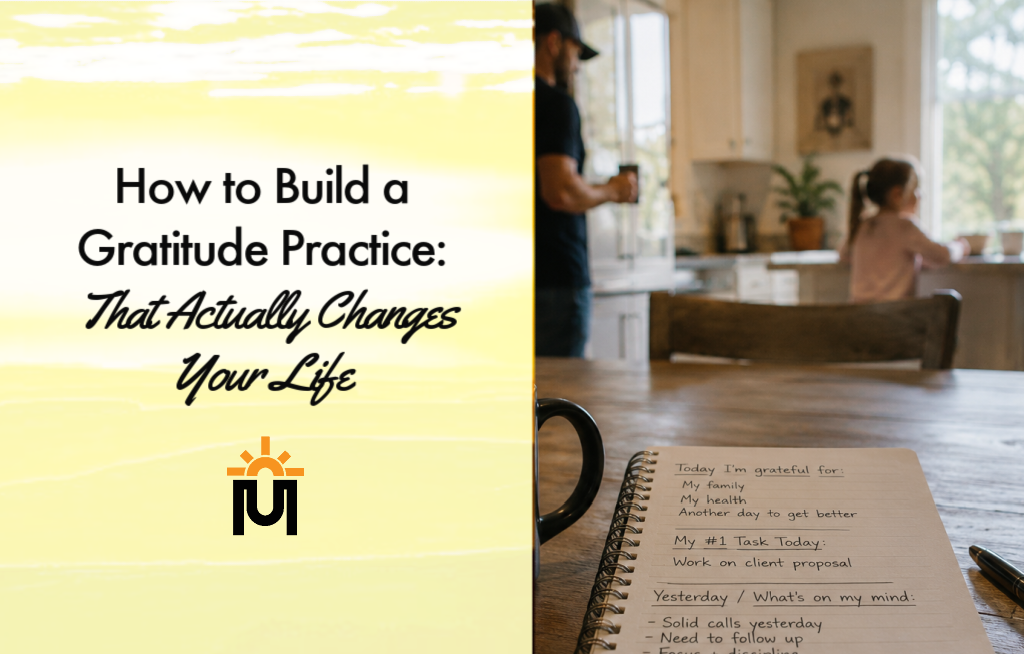
- Today I am grateful for…
- This matters because…
- My number one task today is…
That middle line is important because it keeps gratitude from becoming automatic. “I am grateful for my family” is good. “I am grateful for my family because I do not want to take ordinary time with them for granted” is better.
You can do this in 60 seconds. Some days the answer will be big. Some days it will be simple, like coffee, cool weather, a quiet morning, a healthy body, a finished task, or a good conversation. Both count. The power is in repetition.
A Natural Next Step
If you want a simple place to practice this with other people, I created a Skool community called Grateful Go-Getters. The idea is intentionally simple: post one thing you are grateful for and your number one task for the day.

It is not meant to be a high-pressure productivity group. It is for people who want to stay grounded, focused, and grateful while still moving forward in their life, business, family, health, or personal growth.
You can check it out here:
https://morningupgrade.com/community/
Create Your Personal Gratitude Code
At some point, gratitude has to become more than a list. It has to become a way of seeing your life.
A personal gratitude code is a simple rule you return to when life gets noisy. It reminds you how you want to see your work, your family, your money, your health, and your ordinary days.
One strong version is: “Grateful for what is here. Responsible for what is next.”
That line matters because it keeps both sides alive. You are not giving up your ambition. You are not pretending everything is perfect. You are simply refusing to miss the good that is already present while you keep building.
Final Thought
Gratitude is not a mood you wait for. It is a lens you practice.
When practiced consistently, it helps you stop taking your life for granted. It makes you steadier under stress, more present with people, more respectful of your health, less panicked around money, and more grounded in your ambition.
The goal is not to become perfectly grateful all the time. The goal is to return faster when stress, comparison, familiarity, or pressure pull you away from what matters.
Start small. Notice one thing. Say why it matters. Then take the next responsible step.